
Introduction
Footwear quality control (QC) is the process of ensuring that every pair of shoes meets the required standards of design, performance, and safety before reaching consumers. It involves a series of checks and tests conducted throughout the production process, starting with the selection of materials and continuing through to the final product. The goal of footwear inspection is to catch any defects early on, such as weak stitching, poor material quality, sizing inconsistencies, or bonding failures between the sole and upper.
In today‘s competitive footwear industry, excellence isn’t achieved at the end of the production line—it is built from the very first step. Implementing early- and mid-stage quality control is therefore not just a best practice but a strategic investment that drives quality consistency, efficiency, and long-term customer satisfaction.
- Pre-Production Quality Control
Quality starts before bulk production begins. The first stage of quality control is pre-production preparation, which includes confirming the approved material direction, checking whether the material is stable enough for the intended construction, keeping the approved sample as the production reference, and closing key technical details before bulk starts.
1.1 Incoming Materials Quality Control (IQC)
IQC involves verifying that all incoming components meet the required standards before they reach the production floor. Factories inspect raw materials and components, sorting them as Accepted, Conditionally Accepted, or Rejected against specifications detailed in purchasing orders, production packs, or BOM. Before production begins, leather, fabrics, and soles are inspected for thickness, tear strength, and environmental compliance (like REACH or RoHS).
Key areas of material inspection include:
· Leather/Textiles/Synthetics: Visual and tactile checks for consistency in color, texture, thickness, and grain pattern. Rejection criteria include cuts, holes, scars, excessive creasing, poor dye uniformity, stains, mold, and unacceptable odor.
· Foams & Padding: Density and resilience checks; visual inspection for tearing, crumbling, or permanent deformation.
· Soles (Outsole, Midsole, Insole): Dimensional accuracy, compound hardness (durometer spot checks), flexibility, color consistency, visual defects (flash, bubbles, contamination, warping).
· Hardware (Eyelets, Rivets, Ornaments): Plating quality and adhesion, secure attachment strength test, color consistency, absence of sharp edges.
· Adhesives: Verification of type against specification; storage condition checks.
1.2 Pilot Review (PR)
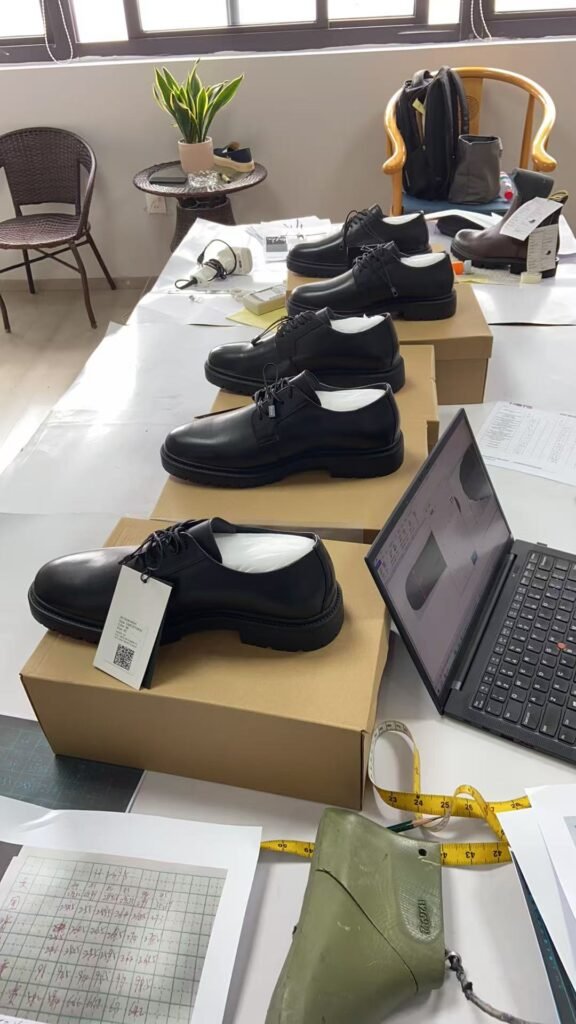
The pilot review confirms that production processes and workmanship meet specifications before bulk manufacturing. Typically, 20–32 pairs are randomly selected for a full visual, conformity, and construction check. Verification of shoe sizing alignment and footwear labels against tech pack happens at this stage. A successful pilot confirms that machinery, materials, and workmanship are ready for bulk production.
- In-Process Quality Control (IPQC)
In footwear production, end-of-line inspection alone is not enough. By the time the shoes are fully assembled and packed, many defects are already difficult to correct without delay, rework, or cost. That is why in-process control is often the most important part of the quality system.
2.1 Cutting and Skiving
Verification of pattern alignment on material, cutting precision, material utilization efficiency, and bundle identification. Consistency of skived edge thickness and width; avoidance of skiving through the material; smooth transitions.
2.2 Stitching and Sewing
· Stitch Per Inch (SPI) consistency verification
· Tension checks (balanced, no looping or puckering)
· Seam alignment accuracy (matching patterns, edge distances)
· Secure back-tacking at seam ends
· Absence of skipped stitches, broken threads, or visible repairs
· Correct thread type and color usage
2.3 Lasting (Upper to Insole Attachment)
Assessment of tension consistency around the last; smoothness of the featherline; absence of wrinkles, puckering, or gaps; secure adhesion/tacking.
2.4 Bonding (Sole Attachment)
· Cleanliness and proper preparation of bonding surfaces
· Correct adhesive application (amount, pattern, coverage)
· Precise component placement and alignment
· Adequate pressure and dwell time during curing
· Post-bonding inspection for gaps, misalignment, or adhesive seepage
- Pre-Shipment Inspection (PSI)
Pre-shipment footwear inspection is essential to ensure your suppliers are meeting your expectations and to address problems if they aren‘t.
3.1 AQL Sampling Method
The Acceptable Quality Limit (AQL) system, defined by ISO 2859-1, allows buyers to inspect a representative sample rather than every single pair, making quality control both cost-effective and reliable for large orders. AQL represents the maximum percentage of defective items considered acceptable in a production batch.
Common AQL levels for footwear include:
· AQL 0.65: Premium luxury shoes requiring near-perfect quality
· AQL 1.0: High-end dress shoes and formal footwear
· AQL 1.5: Standard commercial footwear
· AQL 2.5: Budget-conscious or high-volume orders
· AQL 4.0: Basic footwear with relaxed quality requirements
Sampling plan example: A lot of 3,200 pairs with AQL 1.5 requires a sample of 200 pairs with an acceptance number of 7 defects.
3.2 Visual and Tactile Inspection
The lot shall be first subjected to detailed visual and tactile examination. The defects usually observed on such examination have been broadly divided into two classes: major defects and minor defects.
General inspection process:
· Check for any visible defects or damages on the upper material of the footwear
· Inspect the stitching to ensure it is secure and evenly done
· Look for any signs of discoloration or fading on the material
· Examine the sole for any signs of wear or unevenness
· Ensure that the sole is securely attached to the upper material
· Check the tread pattern for any signs of damage or wear
· Inspect the insole for any signs of peeling or detachment
· Check the size and fit to ensure it matches the labeled size
· Examine the toe box for any signs of deformation or discomfort
· Check the heel area for any signs of instability or unevenness
3.3 Fabric and Material Defects Inspection
Fabric is one of the most critical components in footwear manufacturing, directly affecting both the shoe‘s durability and appearance. When evaluating fabric quality, pay close attention to the following issues: yarn defects (uneven or loose threads), sole material defects (visible cracks, inconsistent thickness, or poor adhesion), weaving issues (irregular patterns or snags), aspect flaws (unusual textures or irregularities), leather defects (scratches, stains, or inconsistent grain texture).
Color defects to check for include unwanted marks or blemishes, uniform color tones across both shoes, and any discoloration or smudges indicating poor handling or inferior dyeing techniques.
3.4 Workmanship Assessment
Even well-designed shoes can be compromised by poor craftsmanship. Key areas to examine include:
· Seam and stitch quality: Uneven stitches, loose threads, or skipped stitches can weaken the shoe
· Thread issues: Mismatched or weak threads that may break over time
· Assembly flaws: Misaligned components, irregular shaping, poor finishing or glued areas showing signs of separation
- Functional and Performance Testing
4.1 Symmetry & Fitting Check
Careful measurement of shoe‘s insole length, insole width, toe lift, heel height, and back height for proper fitting, symmetry, and sizing requirements ensures both shoes in a pair are identical in size and shape. No matter the type of shoe you’re manufacturing, all footwear inspections will include attention to important checkpoints like shoe sizing, sole bonding, and shoe symmetry.
4.2 Durability Testing
Flexibility & endurance tests simulate thousands of steps to check for material cracking.
Common durability tests include:
· Bend test: Assess sole flexibility and resistance to cracking
· Twist test: Evaluate structural integrity under torsional stress
· Abrasion test: Measure sole wear resistance
· Flex test: Test sole separation risk (5,000+ cycles)
4.3 Slip Resistance Test
Verifies the grip of the sole on wet or oily surfaces. Typically tested according to ISO 13287 standard.
4.4 Safety Testing
· Needle Examination: Scans for broken needle shards using automated detectors. Even with perfect stitching, metal fragments or broken needles can be hidden inside the padding or lining. An automated conveyor-belt needle detector acts as the final “gatekeeper” at the end of the line.
· Chemical Safety (REACH / RoHS Check): Ensures materials are free from restricted or toxic substances.
- Packaging and Labeling Inspection
Final inspection includes verifying packaging and labeling requirements:
· Shoebox crush resistance: Stacking test (3 layers @ 48 hours)
· Polybags: Ventilation holes for moisture prevention
· Labeling accuracy: Barcode/QR code scannability; composition, care, size, country of origin, and price tags should be correctly placed and legible
· Recyclable packaging symbols (if eco-certified)
- Defect Classification
Defects are classified based on severity into two main categories:
· Major defects: Defects that affect the functionality, safety, or durability of the footwear, such as sole separation, sharp edges, missing safety labels, or significant sizing deviations. These may cause the product to be unusable or unsafe.
· Minor defects: Cosmetic flaws that do not affect the product‘s performance or safety, such as small stains, loose threads, or minor discoloration that is not readily visible.
- Compliance with International Standards
When importing footwear, ensuring compliance with international regulations is critical. Failing to comply can result in customs delays, product recalls, or serious damage to brand reputation.
United States: CPSIA (Consumer Product Safety Improvement Act) requires testing for harmful substances in children’s products; flammability standards; labeling requirements including fiber content, country of origin, and care instructions.
European Union: REACH regulation restricts chemicals used in textiles and footwear; CE marking indicates conformity with health, safety, and environmental protection standards; textile labeling regulation requires accurate labeling of fiber composition.
International standards: ISO 2859-1 provides the statistical framework for AQL sampling; EN ISO standards evaluate safety and performance of footwear; OEKO-TEX Standard 100 tests for harmful substances in textiles.
Conclusion
A systematic inspection protocol—spanning pre-production, in-process, and pre-shipment stages—is indispensable for footwear quality assurance. By prioritizing material integrity, construction precision, and regulatory compliance, quality control professionals mitigate returns, enhance customer trust, and secure long-term market access. Quality needs to be managed as a process, not treated as a one-time inspection task.